Buyers often shop machining by asking for an hourly rate, then wonder why quotes for the same drawing still differ wildly. This article explains the cost structure underneath: what a machined part's price is actually made of, and where design decisions move it — with no prices quoted, because honest numbers only exist against a real drawing.
A machined part's price bundles material, machine time, setup time spread across the batch, tooling wear, secondary operations, finishing, inspection and packing. The machine's hourly rate touches only some of those. Two parts on the same machine at the same rate can differ fivefold in price because one needs three setups and a finishing route while the other completes in a single clamping and ships plain. Quoting by rate is like pricing a meal by the cook's wage — related, and nearly useless.
This is why our CNC machining services quote from the drawing's operation list rather than from a rate card: the quote is the sum of what your part actually needs. When a design change removes an operation, the saving is visible in the quote — the transparency buyers need to make design trade-offs rationally.
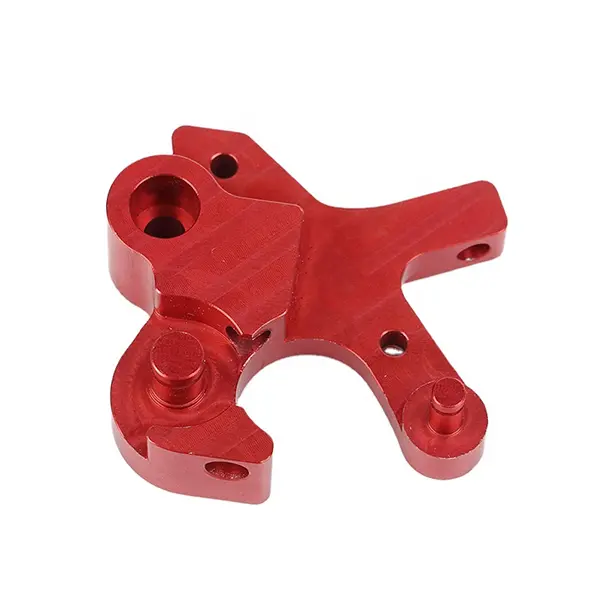
Every time a part must be re-fixtured — turned over, re-clamped, re-datumed — cost and error both enter. Parts whose features are reachable from few directions machine cheaply; parts that hide features on every face machine expensively. Operation count compounds this: milling, turning, drilling, tapping, punching, wire-cutting — this factory's equipment list covers all of them — and each operation a design requires is time, tooling and handling.
The design levers are concrete. Consolidate features onto shared faces where function allows. Prefer hole patterns that drill in one setup. Question every feature that exists because the CAD made it easy rather than because the product needs it. And consider the starting point: a part begun as an extrusion or a casting may skip most of its roughing operations entirely, leaving machining to do only the precision work — a route only a multi-process quote can show you.
Two specifications multiply machining cost without changing the part's shape at all. Tight tolerances everywhere slow cutting, multiply measurement and shrink the acceptable batch fraction — the subject of our tolerances explainer, whose advice is to tolerance selectively: critical where function lives, standard elsewhere. Finishes multiply differently: anodizing and powder coating are separate production routes with masking, handling and inspection of their own, and a part designed without its finish in mind can need expensive corrective preparation.
Neither multiplier is avoidable when the function demands it — precision interfaces and protective finishes are often the entire point of a part. The waste is only in the unexamined cases: tolerances tightened by habit, finishes specified by copy-paste. A good DFM review names both, prices them visibly, and leaves the decision with you.
Setup cost divides by batch size, which is why unit price falls as quantity rises — steeply at first (ten parts versus one hundred), then gently. Material choice sets the floor: stainless steels machine slower and wear tools faster than aluminum, and large parts consume large stock. None of this is negotiable physics; what is negotiable is the design's response to it — nesting small parts, standardising across a product family, or splitting a programme into a trial batch now and production later.
That last pattern is this factory's home ground: with no fixed MOQ and support for small-batch trial production, a programme can start at proving quantity without paying a small-order penalty designed to refuse the work. The low-volume production page explains how trial runs here stay on production routes, so the part you prove is the part that scales.
Send the drawing with material, finish, critical dimensions marked, and honest quantities — trial and expected production. Ask for the quote to show operations and assumptions. Then do the most valuable thing a buyer can do: ask what would make it cheaper. On a real drawing, that question has real answers — a relaxed non-critical band, a merged setup, a cast or extruded starting point — and a factory that runs five processes can offer levers a machine shop cannot. The conversation costs nothing; send it via the contact form.
When two quotes for the same part differ, the difference always lives somewhere specific: an operation one supplier included and another missed, a finish interpretation, an inspection assumption, a starting-stock choice. Ask each supplier to explain their route in operations, and the price gap usually explains itself — occasionally revealing that the cheaper quote is cheaper because it quietly plans to deliver less part.
Tell us the material grade, quantity and finish you need for your project. Our engineers review every drawing for die casting, machining or stamping feasibility before quoting — no obligation.
Send Drawings for a DFM Review